
Is Work-Life Balance Really Better in Europe Than the US?
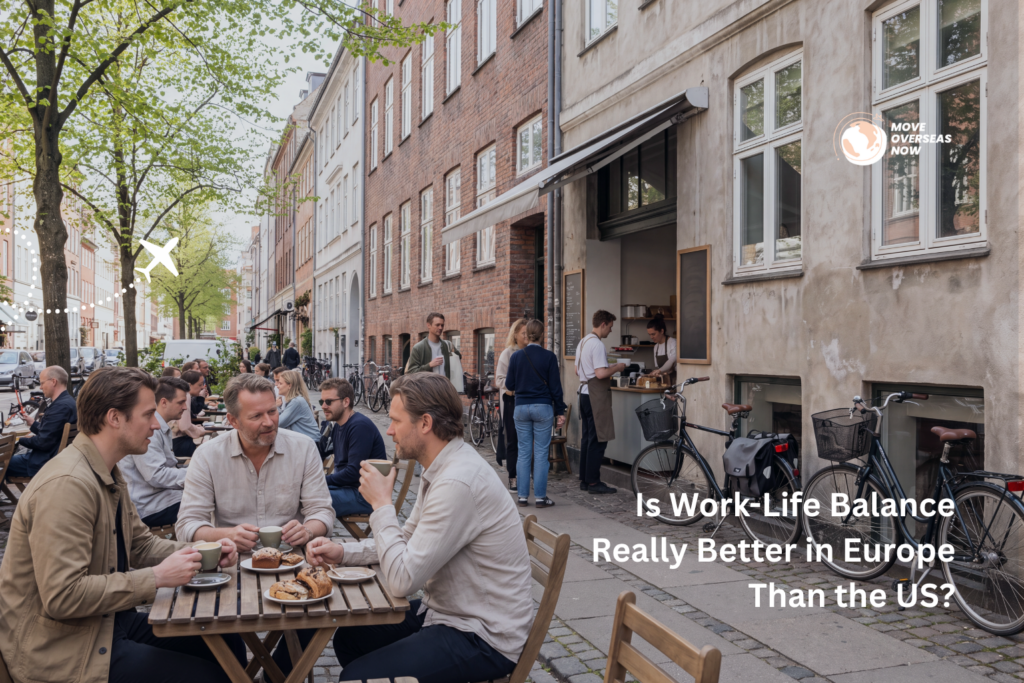
If you've ever stared at two weeks of unused PTO in late November, skipped lunch to get through your inbox, or wondered whether the “Europeans take August off” thing is actually real, you're not imagining the gap. Work life balance in Europe vs the US is one of the most searched comparisons among Americans who are quietly, or not so quietly, questioning whether their relationship with work has to look the way it does.
This isn't a travel inspiration piece. What follows is a data-first breakdown of what actual policies, legal protections, and working hours look like on both sides of the Atlantic, using OECD figures and real expat experience. The comparison isn't just cultural. It's written into law. Once you see the numbers side by side, the vague sense that something is off becomes a lot harder to dismiss.
By the time you finish reading, you'll have concrete metrics to assess your own situation and a clear sense of what questions to ask, whether you're benchmarking your current employer or wondering if a fundamentally different life is possible.
Work life balance in Europe vs the US: how many hours people actually work
The OECD data is striking. U.S. employees average approximately 1,796 hours per year. German workers average around 1,331. That's a difference of 465 hours annually, or roughly 11.5 full-time work weeks. France, Sweden, and the Netherlands cluster even lower. The gap isn't a rounding error, it's the structural outcome of two very different legal frameworks.
How much does it cost to move to Europe: One-time expenses before you leave
The one-time relocation costs are what most people underestimate, largely because they only think about the plane ticket. The reality is that getting yourself and your life to Europe involves several distinct cost categories, and each one deserves its own line in your budget.
What OECD data shows
Raw weekly hours don't tell the full story. European workers take more paid leave and have higher rates of part-time employment, both of which drive annual hours down significantly. The OECD figures reflect a consistent pattern across multiple decades: European workers structurally clock fewer hours, and the legal environment makes that possible.
How legal frameworks differ
In the U.S., the Fair Labor Standards Act doesn't cap weekly hours for adult workers at all. It requires overtime pay after 40 hours, which can function as an accepted operating cost for some employers rather than a meaningful deterrent to long schedules. The EU Working Time Directive takes a fundamentally different approach: it sets a 48-hour weekly average maximum, mandates at least 11 consecutive hours of daily rest, and requires an uninterrupted weekly rest period of at least 35 hours. In plain terms, the EU sets a ceiling, and the U.S. sets an overtime pay trigger. Those are not the same tool, and they produce very different working lives.
Visa comparisons for 10 countries, a budget planner, and more. $33 (down from $197).
Vacation and paid leave: work life balance in Europe vs the US by the numbers
The EU Working Time Directive mandates a minimum of four weeks of paid annual leave across all 27 member states. Most countries exceed that floor by a meaningful margin. Austria, Denmark, France, and Sweden each provide 25 statutory days. Estonia provides 28. Add in public holidays, which range from roughly 6 to 15 days depending on the country, and the EU average lands around 33 total guaranteed rest days per year.
U.S. federal law requires zero paid vacation days. None. The typical private-sector worker starts with about 11 days after the first year, rising to roughly 15 with tenure. Even federal holidays are not required to be paid. For lower-wage workers and people early in their careers, rest is not a legal baseline; it's a benefit that employers grant at their discretion. Some states and cities have enacted sick-leave mandates, but these protections are patchwork, not national.
Access and uptake are also two different things. According to Bureau of Labor Statistics data from 2023, 79% of private-sector U.S. workers have access to paid vacation or PTO, but only 57% actually use all of it. One in four Americans rarely or never takes their full allowance, according to workplace surveys including research from the U.S. Travel Association. The structural and cultural pressure against taking leave undercuts the benefit even where it exists on paper.
Parental leave and sick time: where the comparison gets personal
The Family and Medical Leave Act provides up to 12 weeks of job-protected leave for eligible workers. That leave is unpaid at the federal level. Eligibility requires 12 months of tenure, 1,250 hours worked in the prior year, and an employer with at least 50 employees within a 75-mile radius. That last requirement alone excludes a significant portion of the U.S. workforce. Many workers simply don't qualify for the only federal protection that exists in this area.
Across Europe, the picture looks very different. EU rules require a minimum of 14 weeks of maternity leave and four months of parental leave per parent, but most national systems go well beyond that. Germany replaces approximately 67% of prior net earnings during paid parental leave. Sweden replaces roughly 77, 80%. The EU average sits around 50%. The U.S. federal replacement rate is 0%. That contrast is not subtle.
Sick leave is another area where the structural difference shows up in daily life. In most European countries, sick leave is a distinct legal entitlement tracked separately from vacation, governed by national insurance rules. In the U.S., sick leave is either bundled into a combined PTO bank, meaning illness competes directly with vacation time, or simply unavailable without pay. Workers who push through illness because they can't afford to lose pay or PTO create measurable downstream costs in health outcomes and productivity, a dynamic that rarely gets included in the headline comparison.
What these policies mean for daily quality of life
The 2025 OECD Better Life Index makes the aggregate picture clear. On a 0, 10 scale for work-life balance, reflecting measures like time devoted to leisure and personal care, Spain scores 8.4, Sweden scores 8.1, Germany scores 8.0, and France scores 7.4. The United States scores 5.2. That's a 2.2 to 3.2 point difference that reflects real disparities in leisure time, recovery, and daily wellbeing. U.S. full-time workers devote about 14.6 hours per day to personal care and leisure. Spanish workers average 15.7 hours. Those numbers add up over a lifetime.
The cultural layer is what turns a legal difference into a lived one. In much of Western Europe, rest isn't treated as a reward for exceptional performance, it's a baseline expectation of a functioning working life. Collective agreements and workforce norms in countries like Germany, the Netherlands, and Sweden reflect an assumption that employees will take their full leave. Taking your full vacation isn't a signal that you're disengaged; it's simply what people do. In U.S. corporate culture, the opposite expectation often prevails: availability signals dedication. That norm is shifting in some industries, but the structural incentives haven't changed.
From U.S. corporate life to Barcelona: what the shift actually felt like
I spent years inside the U.S. system before making the move to Barcelona. I understood the OECD data intellectually long before I felt it in my body. What I didn't expect was how quickly the shift showed up in the smallest things: actually stopping for lunch, not answering emails at 9 p.m. without a second thought, staying home when I was sick without calculating how many PTO days I had left. The data I'd read was real. I was now living inside it.
The psychological shift took longer. Years of working in a system where rest felt like something to earn meant that I had to actively unlearn the guilt around not being available. That's not a European problem. It's a cultural residue that travels with you. But the structural environment made it possible to actually change. When the system around you normalizes rest, your nervous system eventually gets the memo.
That experience is exactly what shaped Move Overseas Now Academy. Knowing the data is one thing. Having a clear, structured plan for how to actually make a move, understanding your visa options, sorting your finances, and working through the decision with real guidance, is another. If you're reading this and recognizing your own situation in the numbers, the move abroad toolkit is practical way to start. You can bring all your biggest questions about moving abroad, or, you can book a call with a relocation advisor on my team to talk through what a real transition could look like for you.
How to use this comparison to your advantage right now
Even if moving abroad isn't your immediate goal, these metrics give you a useful benchmark for evaluating your current situation. Pull out your employee handbook and look at four specific things: how many vacation days you're entitled to and how many you actually take; whether sick leave is tracked separately from PTO; what your parental leave policy looks like and whether you'd actually qualify; and what your employer's expectations are around availability outside your scheduled hours. Comparing those answers against the EU statutory floors gives you a concrete sense of where you stand relative to an entire continent's legal baseline.
If you're in a negotiation or a performance review conversation, the OECD data is a legitimate reference point. Knowing that 20 days of paid leave, as mandated by the EU Working Time Directive, is the legal floor across 27 countries gives you a different kind of confidence when you're asking for more.
For readers whose goal isn't just better PTO at their current job but a fundamentally different relationship with time and work: that path exists, and people navigate it every year with the right preparation. You don't have to figure it out alone.
The bottom line
The work life balance gap between Europe and the US comes down to a structural truth: one system guarantees rest by law, and the other leaves it largely to employer discretion and individual negotiation. The OECD hours data, the vacation day minimums, the parental leave replacement rates, and the Better Life Index scores all confirm that the U.S. structurally underprotects worker rest compared to EU baselines. This isn't about blaming yourself for where you are. It's about having accurate information so you can make decisions from a place of clarity rather than vague dissatisfaction.
Some people use this data to negotiate harder at their current job. Some use it to start planning a move. Both are valid responses to understanding the full picture. The one thing that doesn't serve you is staying uninformed. If the numbers in this article confirmed something you've suspected for a while, your next step is straightforward: join the next free live Q&A and see what your options actually look like. If you want personalized guidance after that, you can book a call with a relocation advisor on my team. The data is clear, now you get to decide what to do with it.